What Is ELDT Training? A Complete Guide for CDL Drivers
Summary:
Entry-Level Driver Training (ELDT) is a mandatory federal requirement for new Class A or Class B CDL applicants, certain CDL upgrades, and first-time Passenger, School Bus, or Hazardous Materials endorsements. The training includes both theory instruction and behind-the-wheel practice, and it must be completed through a provider listed on the FMCSA Training Provider Registry. Once the training provider submits the driver’s completion record to the federal system, the applicant can proceed to the CDL skills test and continue toward earning a commercial driver’s license.
Picture this. A guy spends three months studying the commercial driver’s manual. He finally passes his written permit exams, borrows a buddy’s tractor-trailer, and rolls up to the state testing lot feeling like king of the road.
The examiner walks out with a clipboard, taps on the window, and asks one simple question “Where is your TPR certificate?”
The driver stares blankly. He gets sent home without even turning the key.
That exact scenario plays out every single week across the country. Getting your commercial license isn’t just about passing a physical driving test anymore. The rules completely flipped a few years ago. If you are gearing up for a trucking career, missing this one hyper-specific federal step will entirely block you from taking the CDL knowledge test or the road exam. Period.
You cannot bypass it. You cannot sweet-talk the DMV out of it.
So, what is ELDT training for CDL, and why is everyone suddenly making such a massive deal out of it? Let’s cut through the bureaucratic nightmare and break down what you actually need to know before you ever sit in a truck cab.
What Is ELDT Training?
Entry-Level Driver Training (ELDT) is a set of mandatory federal standards established by the FMCSA. It requires all new commercial drivers to complete specific theory and behind-the-wheel instruction from an approved provider before they are permitted to take their CDL skills or knowledge tests.
What Does ELDT Stand For?
ELDT stands for Entry-Level Driver Training. But this federal rule isn’t just for complete rookies. You officially need it if you are getting your first Class A or B CDL, upgrading from a Class B to a Class A, or adding a Hazardous Materials, Passenger, or School Bus endorsement for the first time.
Simply put, it is the mandatory baseline of classroom and cab practice you must finish before the DMV even lets you test.
Why Was ELDT Introduced?
The commercial driving world used to have a terrifying loophole. Even here in California, someone could theoretically grab a Commercial Learner’s Permit (CLP), practice backing maneuvers in an empty lot with a buddy for an afternoon, and go pass a state road exam the very next week.
That was terrifying.
The Federal Motor Carrier Safety Administration (FMCSA) finally stepped in and slammed that door shut with the 49 CFR Part 380 mandate. They introduced the FMCSA ELDT rule to standardize commercial driver education. The ultimate goal? To guarantee that every single rookie jockeying an 80,000-pound commercial motor vehicle down an interstate possesses a legitimate, verified baseline of safety and competence. No more shortcuts. No more “good enough.”
Who Needs ELDT Training?
You must complete ELDT if you are applying for:
- A first-time Class A or Class B CDL
- An upgrade from a Class B to a Class A CDL
- A first-time Passenger (P), School Bus (S), or Hazardous Materials (H) endorsement
If you got your CDL back in 1998, you’re grandfathered in. But if you let that license expire and you’re starting fresh? You have to take an ELDT course. If you drove a straight truck for ten years and now want to haul a 53-foot trailer? You need an ELDT CDL training upgrade. The federal government does not mess around with who needs ELDT training.
What Does ELDT Training Include?
This isn’t a quick weekend seminar. The ELDT requirements force you to actually prove you know what you are doing. The curriculum is split into two massive chunks.
Theory Training
Think of this as the academic grind. You will sit through an ELDT program covering roughly 30 different modules.
You have to learn hours of service rules so you don’t drive exhausted and kill someone. You study cargo securement. You learn about driver safety, whistleblower protections, pre-trip inspections, and how to properly conduct an air brake test without bleeding your tanks dry. The FMCSA mandates you score an 80% or higher on the theory assessment.
Behind-the-Wheel (BTW) Training
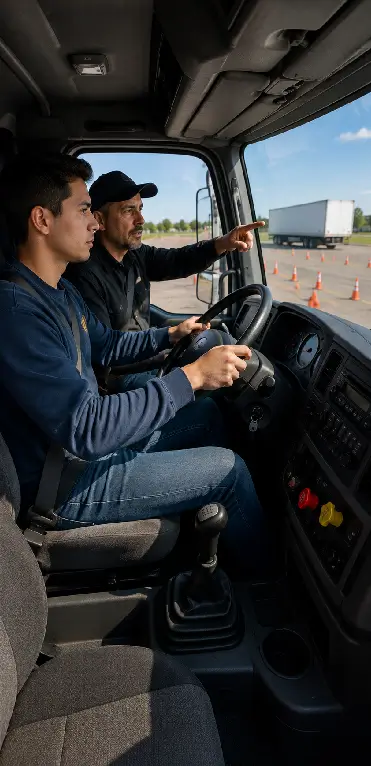
This is the physical crucible of your CDL entry-level driver training. You put the books away and grab the steering wheel.
Range Training
You stay confined in a closed yard. You practice. And practice. And practice some more. The heat baking off the asphalt. The smell of burning diesel and grinding gears. You will master straight-line backing, alley docking, and parallel parking.
Instructor’s Note: I watch students paralyze themselves during the reverse offset backing. Their brains just short-circuit when they have to steer the opposite way the trailer needs to go. Don’t panic. Breathe. Keep your eyes glued to those mirrors and get out and look (GOAL) if you lose your spatial awareness.
Public-Road Training
Then comes the terrifying part. Real streets. You hit actual public highways with an instructor riding shotgun. You learn how to downshift on a steep grade, how to manage the tail swing of a trailer in a tight city intersection, and how to anticipate what the erratic four-wheelers around you are about to do.
Is ELDT Required for a Class A or Class B CDL?
Yes. Indisputably. The overarching federal dogma remains identical for both, though the actual daily slog differs wildly.
Taking a comprehensive Class A CDL training regimen, for instance, requires significantly more blood, sweat, and tears than a Class B program. Why? Because articulating a combination tractor-trailer requires you to understand pivot points and trailer physics, whereas a Class B dump truck operates mostly like a really, really large pickup truck. But federal law demands ELDT certification for both.
Is ELDT Required for CDL Endorsements?
Indeed it is. Moving fifty squirming children or hauling thousands of gallons of combustible fuel requires bespoke instruction.
You cannot just tick a box on a DMV form anymore. If you want to pull a tanker full of gasoline, you have to complete a highly specific ELDT curriculum to earn your Hazardous Materials (H) endorsement. The same goes for the Passenger (P) and School Bus (S) endorsements.
How Does ELDT Training Work?
Here is the exact, step-by-step reality of how to complete ELDT training.
First, you study and pass the written exams at the DMV to secure your Commercial Learner’s Permit (CLP). You cannot touch a truck without it. Next, you fork over your tuition to an officially registered ELDT training provider.
You grind through the theory. You sweat through the behind-the-wheel instruction. Once your instructor finally decides you are competent, the school logs into a federal database the Training Provider Registry (TPR) and digitally uploads your completion certificate.
Only after the state computer system sees that electronic handshake are you officially cleared to meet your CDL skills test requirements and take the physical road exam with an examiner.
How Long Does ELDT Training Take?
Honestly? The clock doesn’t exist.
There are absolutely zero federally mandated minimum hours for behind-the-wheel training. Let me repeat that. Zero. The ELDT training requirements are entirely based on proficiency. If you are a natural who grew up backing up farm equipment, you might blaze through the maneuvers. If you can’t figure out how to double-clutch a 10-speed transmission, you might be stuck on the range for a month.
You graduate when the instructor decides you won’t obliterate a tollbooth. Usually, a solid, comprehensive program takes roughly three to four weeks.
Where Can You Complete ELDT Training?
Don’t just Google “ELDT training near me” and hand your cash to the first guy with a dirt lot and a rusty 1995 Freightliner.
You must attend a school that is permanently cemented on the official U.S. Department of Transportation (DOT) Training Provider Registry. If your chosen facility isn’t on that federal list, your time and money were completely squandered. The DMV won’t recognize your training, and you will have to start over from scratch.
ELDT Training vs. CDL Training
People conflate these terms constantly. What does ELDT training mean compared to normal truck driver training?
ELDT is just the strict federal floor. It is the bare minimum set of legal requirements you have to satisfy to appease the government. General CDL training? That’s the all-encompassing metamorphosis. A great CDL school doesn’t just do the ELDT bare minimum, they handle state-specific test prep, advanced adverse weather driving, and the frantic scramble of job placement afterward.
Why Choose Doaba Truck Driving School for Your ELDT
Picking a school is a colossal gamble. Not every patch of asphalt meets the FMCSA’s rigorous standards.
At Doaba Truck Driving School, we hold pristine TPR approval. Our instructors have ground out decades on the blacktop. We have hauled freight through ice storms, blown tires in the desert, and navigated the worst traffic this country has to offer.
We don’t just spoon-feed you enough basic information to pass a test; we forge you into a resilient, confident, road-ready professional. We meticulously satisfy every mandated theory and BTW requisite, and we upload your TPR paperwork immediately. We take your trucking career seriously, which means you face zero DMV delays when test day finally arrives.
Frequently Asked Questions
Q. What is ELDT training?
A. Entry-Level Driver Training is a federal roadblock requiring rookies to pass mandatory classes and driving practice. You literally can’t take your CDL skills test until an approved school uploads your results to the government.
Q. Who needs ELDT training?
A. If you’re hunting for your first Class A or B CDL, upgrading, or snagging a new Passenger, School Bus, or Hazardous Materials endorsement, you need it.
Q. Is ELDT required for a CDL?
A. Yes. Try showing up to the DMV without it, and they’ll send you packing before you even touch a steering wheel.
Q. What does ELDT training include?
A. It’s a two-part grind. You suffer through classroom safety theory, then sweat it out backing trailers in a yard before hitting real highway traffic.
Q. How long does ELDT training take?
A. There’s no magic federally mandated minimum hour count. You’re stuck there until your instructor decides you won’t obliterate a tollbooth.
Q. Where can I complete ELDT training?
A. Don’t just hand cash to some random guy with a rusty truck. Your chosen school must be cemented on the FMCSA’s official Training Provider Registry, or your certificate is entirely worthless.
Q. Is ELDT required for Class A CDL?
A. Yes. Every single person applying for a brand new Class A license has to jump through this exact same federal hoop.
Q. Is ELDT required for Class B CDL?
A. Yeah, the exact same rules apply. The trucks might be smaller, but the federal government still demands the official training.
Q. Can ELDT training be completed online?
A. You can knock out the boring theory portion on a laptop. But for the actual driving part? You have to be physically sitting inside a real rig.
Q. What is the difference between ELDT theory and behind-the-wheel training?
A. Theory covers the textbook safety rules and regulations. Behind-the-wheel is the visceral reality of physically driving the truck.
Conclusion
Navigating the modern trucking landscape can honestly feel like untangling a knot of government paperwork. But this specific federal prerequisite isn’t just bureaucratic red tape, it is the literal bedrock of your safety, and everyone else’s safety, on the open highway.
You need to know how to handle these heavy machines before you are cut loose in rush hour traffic. Grab your Commercial Learner’s Permit, hunt down an accredited, high-quality school on the TPR, put in the actual hard work, and get your career rolling. The freight isn’t going to move itself.


Leave a Reply
Want to join the discussion?Feel free to contribute!