California CDL Air Brakes Practice Test and Study Guide
Summary:
The California CDL air brakes test evaluates a driver’s knowledge of air-brake components, pressure limits, safety procedures, leakage tests, and inspection requirements. Passing requires understanding systems such as compressors, governors, spring brakes, slack adjusters, dual air circuits, and memorizing critical PSI thresholds for warnings and brake tests. Proper preparation combines studying Section 5 of the California Commercial Driver Handbook, taking practice tests, and gaining hands-on experience with air-brake inspections.
If you want to operate heavy-duty commercial vehicles, you have to master pneumatic braking systems. Most Class A and heavy Class B trucks rely on compressed air to safely stop tens of thousands of pounds of freight. Walking into the DMV unprepared is a fast way to delay your career. To get your commercial license without restrictions, you must pass the written California CDL knowledge test.
We always tell our students that passing this exam comes down to understanding the mechanics and memorizing a few critical pressure limits. This California CDL air brakes study guide cuts out the confusion. We will cover the exact numbers, mechanical components, and safety protocols you need to confidently pass both your written exam and your physical yard inspection.
What Is the California CDL Air Brakes Test?
The California CDL air brakes test is a 25-question written exam that evaluates your knowledge of air-brake systems, components, and safety inspections. Failing this test results in an L-restriction on your CDL, preventing you from operating air-brake-equipped vehicles.
In California, if you take your behind-the-wheel skills test in a vehicle with standard hydraulic brakes, you will also receive this “L” restriction. This legally limits you to driving lighter commercial vehicles, cutting you off from the vast majority of local freight and long-haul driving jobs. You need this endorsement to maximize your earning potential.
What Topics Are Covered on the Air Brakes Test?
The DMV pulls its test material directly from Section 5 of the California Commercial Driver Handbook. Let’s break down the core concepts you need to know.
Air Brake System Components
Your system relies on three main parts working seamlessly. The air compressor pumps compressed air into the steel storage reservoirs (air tanks). The governor acts as the brain of the system, controlling when the compressor pumps air in (cut-in) and when it stops (cut-out) to prevent over-pressurization.
Dual Air Brake Systems
Every modern commercial truck features a dual air brake system. This means the truck has two entirely separate air circuits: a primary system and a secondary system operated by a single brake pedal. If one system develops a severe leak on the highway, the other system retains enough pressure to bring the truck to a safe halt.
Air Pressure and Air Tanks
Maintaining safe operating ranges is non-negotiable. The air tanks store enough pressurized air to allow for several full brake applications, even if the engine stalls. You must manually drain these tanks daily using petcock valves to remove built-up moisture and compressor oil, which can freeze and destroy your valves in cold weather.
Low-Air Pressure Warning
Federal and state laws mandate a foolproof warning system. If the pressure in either your primary or secondary circuit drops below a safe operating threshold, a red dashboard light and a loud audible alarm must activate before the pressure falls below 55 to 60 psi.
Spring Brakes
Air pressure does not hold a parked truck in place; mechanical spring brakes do. Inside the brake chambers, heavy steel springs are held back by continuous air pressure while you drive. When you park and pull the dash valve, the air exhausts, and the mechanical springs clamp down to hold the vehicle. They also act as an emergency braking system if you lose air pressure on the road.
Slack Adjusters
Slack adjusters are mechanical linkages connecting the brake chamber pushrod to the foundation brakes. They keep the brakes properly adjusted as the friction linings wear down over time. You must manually check pushrod travel during your pre-trip walkaround to ensure safe stopping distances.
Air Leakage
The DMV requires you to know how to test the system for leaks. You will be tested on the maximum allowable pressure drops during both a static test (engine off, brakes released) and an applied test (engine off, pedal firmly held down).
Brake Fade
Brake fade is the terrifying loss of stopping power on steep downgrades. It happens when you ride the brakes too hard, causing the drums to overheat and expand away from the brake shoes.
Air Brake Inspection
You must memorize the 7-step in-cab inspection sequence. This involves checking your compressor build-up rate, governor cut-out, applied leakage, low-air warning alarm, and the automatic emergency pop-out of the spring brake valves.
California CDL Air Brakes Practice Test
To get comfortable with the testing format, try these 10 high-value multiple-choice questions natively sourced from training exams. Treat this CDL air brakes practice test as a benchmark.
Q1: Why do we need the air compressor?
To fill the air storage tanks with compressed air.
Q2 What does the Governor control?
It controls the filling of the storage tanks with air by the air compressor.
Q3: What is a dual air brake system?
A system with dual air brake circuits, employing a single set of brake controls.
Q4. What is the function of spring brakes?
To hold the vehicle in place when parked and as an emergency brake system in case of air pressure failure.
Q5: What happens if the air pressure is too low?
When the spring brakes are applied, the vehicle will automatically stop.
Q6 How do you test the low pressure warning signal?
Switch off the engine, leave the electrical power on and pump the brake pedal until the alarm sounds.
Q7. What is a slack adjuster?
A mechanical connection between a brake chamber pushrod and a brake camshaft that is adjustable.
Q8. How do you test for air leaks?
Turn off the engine, release the parking brakes, press the foot pedal firmly and watch the gauge for one minute.
Q9: What is brake fade?
A loss of braking power resulting from heat build-up in the brake drums.
Q10: What should you check during an air-brake inspection?
The compressor build-up rate, governor cut-out pressure, leakage limits, and warning alarms.
Taking a structured California air brakes practice test like this repeatedly is the best way to lock in the terminology before your DMV appointment.
Important Air Brake Numbers to Remember
You have to memorize your PSI limits. If you mix these up, you will fail. Use this cheat sheet for quick memorization.
- Static Leakage Rates: Maximum drop of 2 psi for a single vehicle, 3 psi for a combination of two vehicles, and 5 psi for a combination of three or more vehicles in one minute.
- Applied Leakage Rates: Maximum drop of 3 psi for a single vehicle, 4 psi for a combination of two vehicles, and 6 psi for a combination of three or more vehicles in one minute.
- Low Air Warning: Must activate at or above 55 psi (or half the compressor governor cutout pressure).
- Spring Brakes Pop-out: Normally pops out automatically between 20 and 45 psi.
How to Perform an Air Brake Check
Passing the written exam is only the first hurdle. You must perform a flawless hands-on air-brake inspection for the DMV examiner. Follow this step-by-step framework:
- Secure the Vehicle: Chock the wheels securely.
- Charge the System: Start the engine and let air pressure build until the governor cuts out (around 120-125 psi).
- Static Test: Turn the engine off, turn the key back to the “on” position, and push in your parking brake valves. Wait one minute and confirm pressure drops no more than 2 psi (single) or 3 psi (combo).
- Applied Pressure Test: Press firmly on the foot brake. Hold it for one minute. Confirm pressure drops no more than 3 psi (single) or 4 psi (combo).
- Low-Pressure Warning Test: Fan the brake pedal by pumping it. Watch the gauge. Ensure the buzzer and light come on at or above 55 psi.
- Spring Brake Pop-out Test: Continue fanning the brake pedal. Verify that the parking brake valves pop out between 20 and 45 psi.
Common California CDL Air Brakes Test Mistakes
In our years of teaching in Santa Clara, the biggest mistake students make is confusing the static and applied leakage numbers. Remember that when you physically step on the pedal for the applied test, the system is working harder, which is why the state allows exactly 1 extra psi of leakage.
Another common error is misunderstanding when spring brakes engage. Beginners often think air pressure pushes the brakes against the drum. It is the opposite. Air pressure holds the heavy springs back. When you lose air, the mechanical spring is released and clamps down.
Tips for Passing the California CDL Air Brakes Test
Do not just skim the handbook. Read Section 5 completely and memorize the exact PSI thresholds. Take the time to visualize the dashboard gauges in your head while you study. Knowing that the governor cuts out at 125 psi and the warning alarm triggers at 55 psi will give you immense confidence. Use practice tests to get used to how the DMV phrases their multiple-choice options.
Why Choose Doaba Truck Driving School?
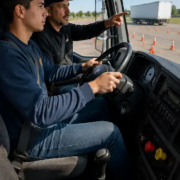
Passing the written test is only step one. Passing the hands-on vehicle inspection and the physical skills test requires professional, behind-the-wheel ELDT training. You cannot learn how to handle a 53-foot trailer just by reading a manual.
Doaba Truck Driving School is the premier destination for CDL training in Santa Clara. We have years of experience helping Bay Area students remove the “L” restriction and master their air brakes tests. Our state-of-the-art training trucks are equipped with standard dual air brake systems, giving you the exact real-world practice you need.
Our certified instructors boast high first-time pass rates because we focus heavily on the pre-trip inspection yard work. We encourage all aspiring drivers to enroll in our Class A or Class B programs to get the hands-on experience required before heading to the California DMV.
Frequently Asked Questions
Q. What is the California CDL air brakes test?
A. The California CDL air brakes test evaluates your knowledge of air-brake systems, components, inspections, pressure, leakage, and safe operation.
Q. What topics should I study for the California CDL air brakes test?
A. Study dual air brake systems, air pressure, reservoirs, compressors, slack adjusters, spring brakes, low-air warnings, air leakage, brake fade, and air-brake inspection procedures.
Q. What is a dual air brake system?
A. A dual air brake system uses two separate air circuits (a primary and secondary system) to provide additional braking-system reliability if one circuit develops a problem.
Q. What do slack adjusters actually do?
A. They connect the brake pushrod to the brake shoes. They keep your brakes tight as the linings wear down so you don’t lose your stopping power.
Q. How do I check for air leaks?
A. Shut the engine off and release your parking brakes. Just watch the gauges for the static test, then hold the brake pedal down hard for one full minute to check for pressure drops during the applied test.
Q. What is the low-air warning?
A. It is a loud buzzer and a bright red dashboard light that go off if your air pressure drops to a dangerous level. By law, this warning absolutely has to kick on before your gauge drops below 55 psi.
Q. What are spring brakes for?
A. Air pressure doesn’t hold a parked truck in place—heavy steel springs do. If you lose your air pressure on the highway, these massive mechanical springs automatically expand and lock the brakes to stop the rig.
Q. What happens if I fail the written air brakes test?
A. The California DMV will slap an “L” restriction on your permit. That letter means you legally cannot drive any commercial truck that uses air brakes, which pretty much rules out most Class A driving jobs.
Q. How should I prepare for the CDL air brakes test in California?
A. Read Section 5 of the handbook a few times, drill the specific PSI numbers into your head, and take as many practice tests as you can. After that, you need to sign up for professional ELDT training to learn the actual hands-on yard inspection.
Q. Where can I get CDL training in Santa Clara?
A. Doaba Truck Driving School offers full Class A, Class B, and ELDT programs right here in Santa Clara. We spend a lot of time in the yard doing hands-on air brake inspections so you know exactly what to do when the DMV examiner is sitting in the cab with you.
Wrapping Up Your Preparation
Getting your commercial license opens up a lot of great paying jobs, but you have to prove you can handle the heavy equipment safely. Drill those PSI limits into your head, understand what your compressor is actually doing, and run through the inspection steps until you can do them in your sleep.
Use these CDL air brakes test questions to see where you stand right now. When you feel ready, book your training with Doaba Truck Driving School. We will get you in the yard, walk you through the physical inspection, and help you get on the road safely.